Yes, will renters insurance cover stolen items? Usually answered with a qualified yes. Personal property protection commonly covers belongings taken during a burglary or another covered theft. Your payment still depends on your deductible, coverage limit, item-specific limits, and whether the policy pays actual cash value or replacement cost.
Renters should check the exact terms before assuming every possession is fully protected. Expensive jewelry, cash, business equipment, and certain collectibles often receive limited coverage.
| Key question | Typical answer |
| Is theft from your rental covered? | Usually, when theft is a covered peril |
| Are belongings stolen elsewhere covered? | Often, through off-premises protection |
| Is car damage covered? | No; the belongings may be covered, but not the vehicle |
| Will you receive the original purchase price? | Not always; the policy may deduct depreciation |
| Do deductibles apply? | Yes, in most claims |
| Are expensive valuables fully protected? | Not always; sublimits or extra coverage may apply |
Direct answer: A tenant policy generally covers personal belongings stolen from your apartment, car, hotel room, or another temporary location. The insurer subtracts your deductible and applies policy limits. Coverage may be reduced for cash, jewelry, collectibles, business property, and other valuables. Always review your declarations page and exclusions.
Will Renters Insurance Cover Stolen Items From Your Home?

Most policies list theft as a covered cause of loss. This means personal property taken during a break-in may qualify for reimbursement.
Covered belongings often include:
- Clothing
- Furniture
- Televisions
- Laptops and tablets
- Kitchen appliances you own
- Bicycles
- Books and household goods
The building itself is treated differently. Your landlord’s policy generally protects the structure, not your possessions. For example, the landlord may handle a damaged apartment door. Your personal property protection may handle the stolen television.
The Texas Department of Insurance states that a landlord’s policy does not cover a tenant’s personal items. It also notes that most tenant policies cover losses caused by theft, subject to the contract’s terms and limits.
Does Theft Coverage Apply Away From Your Apartment?
Many policies include off-premises coverage. This can protect possessions temporarily located outside your rental home. Possible examples include a laptop stolen from a hotel, luggage taken during a trip, or a bicycle removed from a public rack. Property taken from a storage unit may also qualify, although lower limits can apply.
Progressive says personal property protection may cover items stolen from vehicles, storage units, or while traveling. Travelers also explains that belongings can remain protected at home, on vacation, or inside a parked car. Check for an off-premises limit before filing. Some contracts restrict payment when property is stored at another residence or in a storage facility.
What Happens When Items Are Stolen From a Car?
Personal possessions inside a car may be covered, but damage to the car usually isn’t. Suppose someone breaks a window and takes your backpack and laptop. Your property policy may cover the bag and computer. Comprehensive auto coverage typically covers a broken window, a damaged lock, or theft of the vehicle itself.
Built-in equipment creates another distinction. A factory stereo, installed navigation system, or custom part may be considered part of the vehicle. Those items may fall under auto coverage rather than a tenant policy.
GEICO explains that personal belongings taken during a car break-in may qualify, while physical damage to the vehicle is handled separately. The company also notes that insurers often request a police report and proof of ownership.
Visit our Interior Designing category for expert home design tips.
How Much Will the Insurance Company Pay?
A covered loss doesn’t guarantee reimbursement for the full purchase price. Four factors affect the payment.
1. Your personal property limit
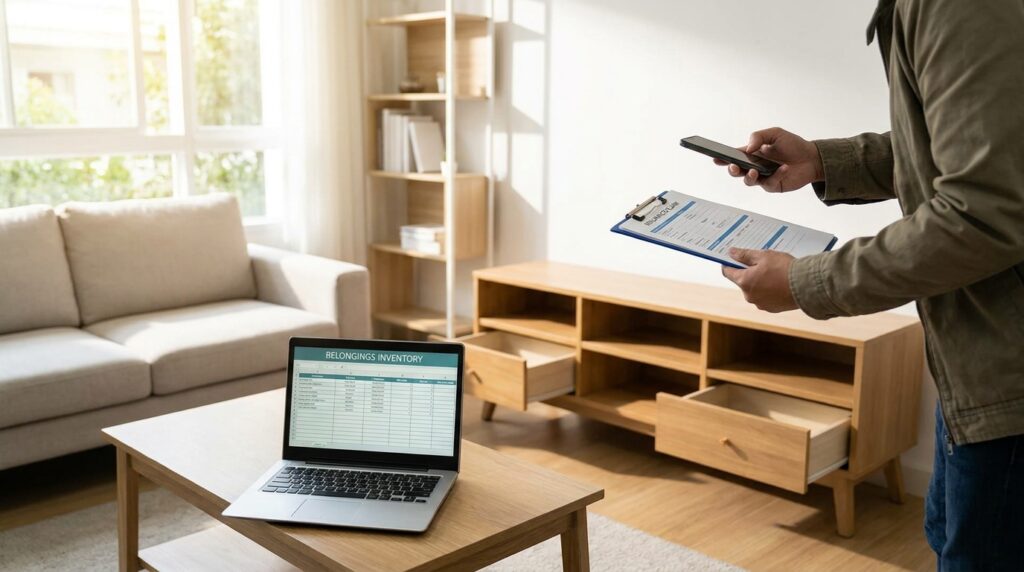
This is the maximum the insurer can pay for covered belongings. A $20,000 limit won’t provide $25,000 for a total covered loss. Create a home inventory before choosing a limit. List your furniture, clothing, electronics, appliances, sports equipment, and other property. Add estimated replacement prices instead of guessing based on the largest items.
2. Your deductible
The deductible is the part of the loss you pay. Assume stolen belongings qualify for a $2,000 payment and your deductible is $500. The claim payment could be $1,500, subject to other policy terms. A small theft may not be worth claiming. If a $400 phone is stolen under a $500 deductible, the policy may pay nothing.
3. Actual cash value or replacement cost
Actual cash value accounts for age and depreciation. Replacement cost is based on the cost of buying a comparable new item.
For example, a five-year-old television may have a current cash value of $200, even if a similar new model costs $500. An actual-cash-value contract may pay around the lower figure. Replacement-cost protection may reimburse the cost of the new equivalent, minus the deductible.
Progressive and Travelers both distinguish between depreciated-value settlements and replacement-cost settlements.
4. Special limits for valuable property
Some categories have sublimits. A sublimit caps payment for a certain type of property, even when the overall personal property limit is much higher.
Common restricted categories include:
- Cash and coins
- Jewelry and watches
- Antiques
- Fine art
- Collectibles
- Silverware
- Firearms
- Property used for business
The California Department of Insurance identifies jewelry, antiques, collectibles, fine art, silverware, and money as categories that may receive limited coverage. It advises consumers to consider scheduling valuable items separately.
When Might a Theft Claim Be Denied?

A policy can reject a claim when the event or property falls outside its terms.
Possible reasons include:
- The policy had expired before the theft.
- The stolen item belonged to an uninsured roommate.
- The loss was reported as theft, but evidence suggests it was misplaced.
- The claimant cannot show ownership or value.
- The property was used mainly for an excluded business purpose.
- The loss exceeded an off-premises or category sublimit.
- The theft involved someone insured under the same contract.
- The policy excludes the circumstances surrounding the event.
Lost and stolen do not mean the same thing. Standard protection often covers theft but not an item you accidentally leave behind. An endorsement may be available for broader protection on selected valuables. Never change the facts to make a loss appear covered. Provide the insurer with accurate information and request a written explanation if the claim is denied.
How to File a Claim for Stolen Belongings
Act quickly, but document the scene before cleaning or replacing anything.
- Move to a safe place. Don’t enter a property if you think the intruder may still be there.
- Contact the police. Request a report number and a copy of the completed report.
- Notify your landlord. Report any damage to doors, locks, windows, or common areas.
- Photograph the scene. Capture signs of forced entry and the locations where property was taken.
- List each stolen item. Include the brand, model, age, serial number, and estimated value.
- Gather proof of ownership. Use receipts, order histories, photos, warranty records, packaging, or bank statements.
- Contact the insurer. Ask about deadlines, required forms, the deductible, and the expected claims process.
- Keep claim records. Save emails, report numbers, estimates, and notes from phone calls.
Progressive recommends notifying the property manager, filing a police report, and contacting the insurer after a theft.
If you’re interested in growing your real estate knowledge, explore our Property Investment category for expert guides on buying, selling, financing, and investing in property.
A Simple Claim-Payment Example
Imagine a thief takes three items:
| Stolen property | Settlement value |
| Laptop | $900 |
| Headphones | $150 |
| Bicycle | $650 |
| Total covered value | $1,700 |
With a $500 deductible, the potential payment would be $1,200. That calculation assumes every item qualifies and no sublimit applies.
Now assume the bicycle has a separate $300 category limit. The covered total could fall by $350, reducing the potential payment to $850 after the deductible.
This example shows why the headline coverage limit doesn’t tell the whole story. Deductibles, valuation methods, sublimits, and endorsements can change the final result.
How to Protect Your Belongings Before a Theft
Build a home inventory while you still have access to every item.
Photograph each room and save receipts for expensive purchases. Record serial numbers for computers, phones, cameras, bicycles, and gaming systems. Store the files in a secure cloud account rather than only on a device kept at home.
Review the inventory once a year. Update the policy after buying expensive equipment, jewelry, artwork, or collectibles. Ask whether those items require an endorsement or a scheduled property addition.
You should also compare the value of your possessions with your current coverage limit. A low limit can leave a large gap after a burglary.
Check Your Policy Before You Need It
The best time to review theft protection is before anything disappears. Confirm your property limit, deductible, settlement method, off-premises protection, and valuable-item sublimits.
Create an inventory and ask your insurer about any unclear language. A brief review now can prevent an unexpected coverage gap during a claim.
If you want to learn about Short-Term Rental Insurance, please visit our Rentals category.
Frequently Asked Questions
An insurer may require a police report to confirm that a theft occurred. Report the crime promptly and keep the incident number. Even when the contract doesn’t explicitly demand a report in every case, official documentation can support the claim.
Usually not unless the roommate is named as an insured. Unrelated roommates commonly need separate policies. Travelers notes that a tenant’s contract generally covers a spouse and children but not an unrelated roommate.
Cash may be covered, but the limit is often much lower than the main property limit. Check the special-limits section before making assumptions about currency, coins, gift cards, or similar property.
Bicycles often qualify as personal property, including when taken away from home. Expensive models may require additional protection due to category or total coverage limits.
It may. A broken window isn’t always required to prove theft. The insurer will review the police report, your statement, available evidence, and the contract’s conditions.