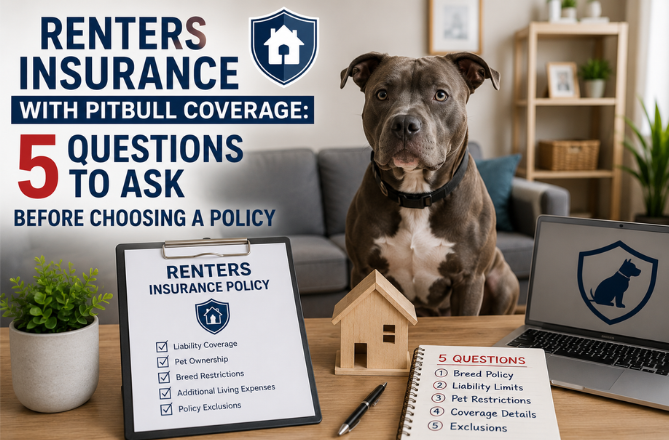
Finding a policy that accepts your dog is only half the job. You also need written confirmation that dog-related injuries and property damage aren’t excluded from your personal liability protection.
When shopping for renters insurance with pit bull coverage, compare the policy wording, not just the company name. Breed rules can vary by insurer, state, dog history, and underwriting program. A policy may insure your belongings while excluding all claims related to your dog.
Direct answer: Some renters policies cover pit bull-type dogs, but many restrict breeds or exclude animal liability. Ask the insurer to confirm in writing that your dog is eligible, and that dog-caused injuries are covered. Review the liability limit, exclusions, bite-history rules, and landlord requirements before buying the policy.
| What to check | Why it matters |
| Animal liability exclusion | Determines whether injuries or damage caused by your dog are covered |
| Breed restriction | May exclude pit bull-type dogs or prevent policy approval |
| Liability limit | Sets the maximum the insurer may pay for a covered claim |
| Dog-bite history | A prior incident can lead to an exclusion or denial |
| Landlord requirements | Your lease may require a specific limit or proof of coverage |
| Standalone animal liability | Can fill a gap when the main policy excludes your dog |
Key Takeaways
- A policy can cover your belongings yet exclude liability caused by your dog.
- Carrier rules differ by location, underwriting program, and claim history.
- Never assume a verbal statement changes the written policy.
- Accurately disclose your dog during the application process.
- Standalone animal liability may help when a standard policy excludes your pet.
- Your landlord’s policy and lease rules remain separate from your own coverage.
Why Pit Bull Owners Face Coverage Restrictions
A standard tenant policy typically combines personal property, loss of use, medical payments, and personal liability protection. The liability section may respond when a covered household member causes injury or property damage.
Dogs create an added underwriting concern because a serious incident can lead to medical bills, legal costs, and a settlement. Insurers may respond by declining the application, excluding the dog, restricting certain breeds, or reviewing each animal individually.
GEICO notes that breed restrictions can vary by insurer and may include pit bulls, Rottweilers, Dobermans, and other large or protective breeds. Liberty Mutual also advises renters to check for breed exclusions when reviewing pet-liability protection.
The result is an important distinction: policy approval doesn’t prove dog liability is covered. An insurer might provide coverage for theft, fire, and other risks while attaching an animal liability exclusion.
How to Find Renters Insurance With Pit Bull Coverage
1. Disclose your dog on the application
Tell the insurer your dog’s breed or mix, age, weight, and history. Answer each application question accurately, even when you’re unsure how the insurer will classify the animal.
Hiding a dog can put later coverage at risk. Reuters has reported on court disputes in which nondisclosure or inaccurate application information allowed insurers to challenge or rescind coverage.
For a mixed-breed dog, use the description shown in veterinary or adoption records. Don’t change the breed description to avoid underwriting questions.
2. Ask whether animal liability is included
Don’t ask only, “Will you insure me?” Ask whether the personal-liability section covers bodily injury or property damage caused by your specific dog.
Request clear answers to these questions:
- Is there an animal-liability exclusion?
- Does the policy contain a restricted-breed endorsement?
- Is there a lower limit for dog-related claims?
- Are incidents away from home covered?
- Does the insurer exclude injuries to other animals?
- Will legal-defense costs reduce the liability limit?
- Does a prior bite or complaint change eligibility?
Ask the agent to point to the relevant policy language. Save the email, quote paperwork, declarations page, and endorsements.
3. Compare liability limits
Many landlords request at least $100,000 in personal liability protection, although lease requirements vary. The amount shown on the declarations page is the most the insurer may pay for covered liability, subject to the contract’s terms.
A low limit can leave you responsible for costs above that amount. That matters because dog-related claims can include emergency care, follow-up treatment, lost income, legal fees, and settlements.
Dog-related injury claims have produced substantial losses for property insurers. Reuters reported that such claims cost U.S. homeowners insurers more than $1.1 billion in 2023, citing data from the Insurance Information Institute.
Compare available limits, such as $100,000, $300,000, or $500,000. Don’t assume the highest limit is automatically available when an animal endorsement applies.
4. Check the lease and landlord’s policy rules
Your own insurance doesn’t override an apartment’s pet policy. A landlord may prohibit certain breeds, impose a weight limit, require a higher liability limit, or request proof that animal liability is included.
The property owner’s insurer may also place conditions on dogs kept at the building. Your policy does not force that company to accept the exposure.
Ask the landlord for the requirement in writing. Confirm whether they need to be listed as an “additional interest,” which normally allows them to receive policy notices. Avoid naming a landlord as an “additional insured” unless your insurer approves that request and explains its effect.
5. Get final confirmation before paying
Insurance rules can change between companies, states, and policy forms. A carrier mentioned on an online list may use different underwriting rules in your ZIP code.
Before purchasing, send the agent a written summary:
“Please confirm that my dog has been disclosed, the policy does not exclude my dog based on breed, and covered injuries caused by the dog fall under the stated liability limit.”
Check the issued documents again after payment. The final contract controls coverage, not an advertisement or an informal carrier list.
Visit our Interior Designing category for expert home design tips.
Comparing Your Main Coverage Options

Standard coverage: pros and cons
Pros
- One insurer and one renewal date
- Personal property and liability packaged together
- Often simpler proof for a landlord
Cons
- Breed restrictions may apply
- A bite history may cause denial
- Dog-related claims may have a lower limit
Standalone liability: pros and cons
Pros
- Designed for animal-related liability
- May consider dogs excluded elsewhere
- Can supplement a policy with an animal exclusion
Cons
- Adds another premium
- Terms differ from the tenant policy
- May exclude prior incidents or known aggressive behavior
Recommended Approach
Start with an independent insurance agent who can compare several underwriting programs. Give the agent the same details for every quote, then request written confirmation for each option.
The strongest choice is usually a standard policy that clearly includes your dog under its full personal-liability limit. It keeps your protection in one contract and may make landlord documentation easier.
When that option isn’t available, pair a standard tenant policy with standalone animal-liability protection. Confirm how the two contracts interact and whether either contains overlapping exclusions.
Avoid choosing a policy that excludes your dog unless you understand the gap and have a separate plan to cover it.
What Can Affect the Price?
The dog’s breed may affect eligibility more often than the base price. Once accepted, your premium can also depend on:
- Your ZIP code
- Personal-property limits
- Liability limits
- Deductible
- Claim history
- Building type
- Safety features
- Selected endorsements
- Prior dog incidents
Don’t rely on a national “average cost” to set your budget. Quotes reflect local claim trends, policy forms, personal details, and the insurer’s current underwriting rules.
What Happens After a Prior Bite?

A prior bite, injury, insurance claim, animal-control report, or documented aggressive incident can narrow your options. Some carriers may decline the application. Others may issue a policy that excludes the dog.
ValuePenguin reports that insurers commonly deny dog liability after a previous bite, while available treatment still varies by company and jurisdiction.
Be ready to provide:
- The date and circumstances of the incident
- Animal-control records
- Claim documents
- Training certificates
- Veterinary records
- Proof of fencing or secure containment
- Evidence that required corrective steps were completed
These records don’t guarantee approval, but they give an underwriter a clearer account of the risk.
Service Animals and Assistance Animals
Housing rights and insurance underwriting are related but separate issues. A tenant may have protections under federal or state housing law, yet an insurer may still review the animal in accordance with applicable insurance rules.
Don’t assume an assistance-animal designation automatically creates liability coverage. Ask the housing provider about accommodation procedures, then ask the insurer how the policy addresses the animal.
Because these rules depend on the facts and jurisdiction, seek guidance from a qualified housing organization, state insurance department, or attorney when a dispute arises.
Get Written Proof Before You Move In
Collect quotes from several carriers or an independent agent. Provide complete details about your dog, then compare every exclusion and endorsement.
Before signing a lease or paying for a policy, ask for written confirmation that dog-caused liability is included. Keep that confirmation with your declarations page and full contract. This final check can prevent a costly surprise after an incident.
If you want to learn about Will Renters Insurance Cover Stolen Items?, please visit our Rentals category.
FAQs
Choose a policy that confirms your dog’s eligibility in writing, and that lacks a breed-based animal liability exclusion. Compare liability limits, endorsements, deductibles, and bite-history rules. If a standard insurer excludes your dog, consider a separate animal liability policy.
Personal liability may cover a dog bite when the policy includes animal liability and no exclusion applies. Coverage depends on the issued contract, the incident, the dog’s history, and local law.
A landlord may reject proof that doesn’t meet the lease requirements. They may request a specific liability limit, the current declarations page, or an additional-interest listing. A policy also doesn’t cancel a building’s lawful pet restrictions.
Not necessarily. Umbrella coverage often follows the underlying policy’s requirements and contains its own exclusions. Ask both insurers to confirm whether the dog is eligible before relying on an umbrella policy.
No. Pet health insurance helps pay eligible veterinary expenses for your animal. Dog liability protection covers injuries or property damage your animal causes to someone else.