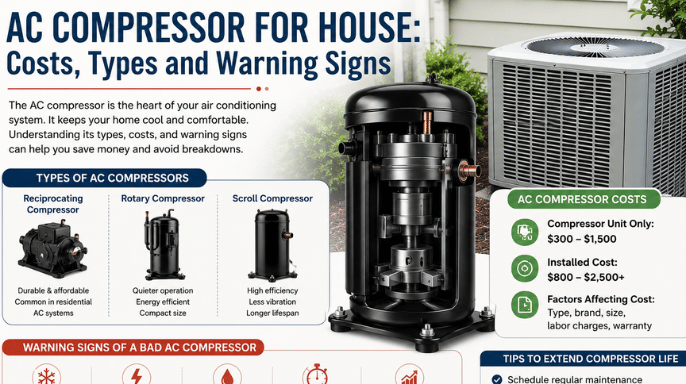
An AC compressor for house cooling circulates and pressurizes refrigerant so your air conditioner can move indoor heat outside. When this component fails, the system may blow warm air, make unusual noises, trip a breaker, or stop cooling completely.
Compressors are expensive and technically complex. Before approving a replacement, ask an HVAC technician to confirm the diagnosis, check warranty coverage, and compare the repair cost with the price and expected life of a new system.
| Key fact | What homeowners should know |
| Main function | Pressurizes and circulates refrigerant |
| Typical location | Inside the outdoor condenser unit |
| Common residential types | Scroll, rotary, reciprocating, and variable-speed |
| Common failure clues | Warm air, noises, breaker trips, hard starting, high bills |
| Typical service life | Often 10–15 years with suitable maintenance |
| DIY replacement? | No, refrigerant and high-voltage work require trained technicians |
| Repair decision | Compare system age, warranty, refrigerant, and total replacement cost |
Direct answer: A home air-conditioning compressor drives the cooling cycle by raising the pressure and temperature of refrigerant. This lets the outdoor coil release heat collected from inside your home. If it stops working, the system cannot transfer heat correctly, even when the indoor fan and outdoor fan still run.
What Does a Home Air-Conditioning Compressor Do?
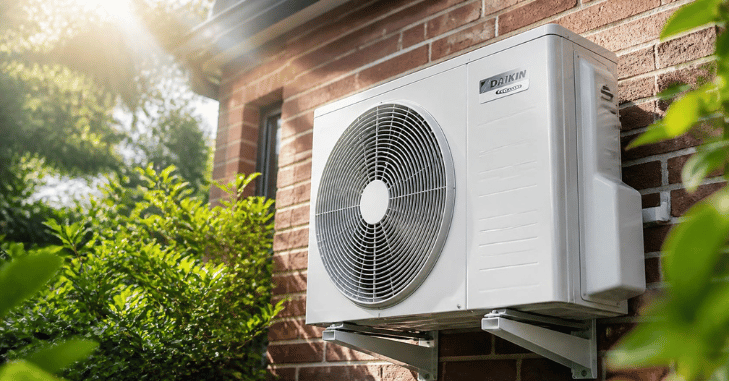
An AC compressor for house systems sits inside the outdoor condenser cabinet. It receives cool, low-pressure refrigerant vapor from the indoor side of the system. This raises its pressure and temperature before sending it through the outdoor condenser coil.
The refrigerant releases heat outside, becomes a liquid, and returns indoors to collect more heat. Carrier describes the component as central to refrigerant circulation and residential heat exchange. Trane also notes that the cooling system cannot produce cold air without proper refrigerant movement and pressure.
The compressor should not be confused with the entire outdoor unit. The outdoor cabinet also contains a condenser coil, fan, electrical controls, and other parts.
Common Compressor Types for Residential Systems
The correct compressor depends on the equipment design. You normally cannot replace one type with another unless the manufacturer approves the match.
Scroll compressors
Scroll designs use two spiral-shaped pieces. One remains fixed while the other moves to compress refrigerant.
They have fewer moving parts than older piston designs and are common in modern central-air systems and heat pumps. Their smooth operating motion can support quieter performance.
Rotary compressors
Rotary designs use a rolling or rotating mechanism. They are compact and commonly found in ductless mini-splits, window systems, and some smaller residential units.
These models can run quietly and efficiently when correctly matched to the equipment.
Reciprocating compressors
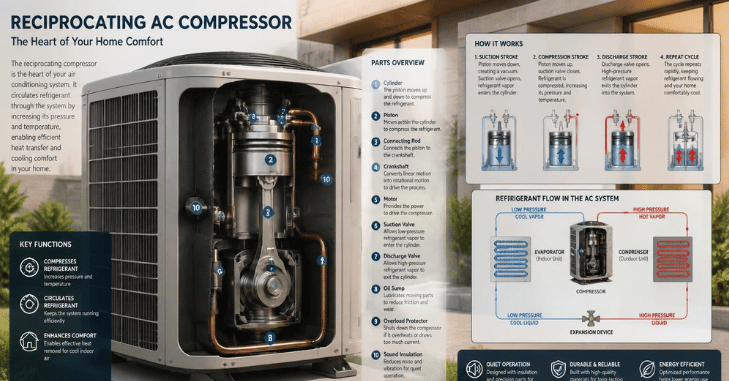
A reciprocating model uses pistons and a crankshaft. This older design remains present in many residential systems. It may cost less than newer technologies, but it usually has more moving parts. That can mean more vibration and mechanical wear.
Variable-speed compressors
A variable-speed or inverter-driven AC compressor for a house can adjust its output rather than operating only at full power. This helps the system maintain steadier indoor temperatures. It may also reduce noise and energy use during long cooling periods. Fixed-speed units cycle fully on and off, while inverter systems can vary their speed according to cooling demand.
| Type | Common application | Main benefit | Possible drawback |
| Scroll | Central air and heat pumps | Quiet, smooth operation | Replacement may cost more |
| Rotary | Mini-splits and compact units | Small size and low noise | Must closely match the system |
| Reciprocating | Older or budget systems | Familiar, proven design | More vibration and moving parts |
| Variable-speed | Higher-efficiency systems | Better temperature control | Higher parts and service costs |
Signs an AC Compressor for House Cooling May Be Failing
A single symptom does not prove compressor failure. A bad capacitor, contactor, thermostat, fan motor, dirty coil, airflow restriction, or refrigerant problem can produce similar results.
Arrange a professional diagnosis when you notice several of these signs:
- The vents release warm or room-temperature air.
- The outdoor unit hums but does not start.
- You hear grinding, clattering, screeching, or repeated clicking.
- The circuit breaker trips when cooling begins.
- The system starts and stops too often.
- Cooling performance drops while electricity use rises.
- The outdoor fan runs, but the home remains warm.
- Oil residue or refrigerant leakage appears near the unit.
Trane advises homeowners to avoid touching a leaking or malfunctioning outdoor unit. The equipment contains high voltage, and refrigerant service requires specialized training and tools.
What can you check safely?
Before calling for service, you can complete a few basic checks:
- Confirm the thermostat is set to cooling.
- Replace a dirty return-air filter.
- Check whether supply vents are open.
- Remove leaves and loose debris around the outdoor cabinet.
- Look for a tripped breaker without repeatedly resetting it.
- Note any sounds, odors, or error messages.
Do not open electrical panels, connect gauges, release refrigerant, or attempt to jump-start the equipment.
How Much Does an AC Compressor for House Systems Cost?

Replacement costs depend on system capacity, compressor design, equipment brand, local labor rates, warranty coverage, and refrigerant requirements.
Recent manufacturer guidance places many residential replacement jobs between roughly $800 and $2,900, although complex variable-speed equipment can cost more. Bryant cites a 2026 range of about $800 to $2,500, while Trane references a broader estimate of $900 to $2,900.
Your estimate may include:
- Diagnostic labor
- The replacement part
- Refrigerant recovery
- Removal of the failed component
- Filter-drier replacement
- Brazing and pressure testing
- Vacuum evacuation
- Refrigerant charging
- Electrical testing
- Cleanup and final performance checks
A parts warranty may cover the compressor while leaving labor, refrigerant, shipping, and related materials to the homeowner.
Ask for a written quote that separates each cost. Also ask whether the technician found the cause of failure. Installing another component without correcting low airflow, contamination, an electrical fault, or an incorrect refrigerant charge may lead to another breakdown.
Should You Replace the Compressor or the Whole AC Unit?
Replacing the failed part can make sense when the system is fairly new, otherwise reliable, and covered by a strong parts warranty.
A full system replacement may offer better value when:
- The equipment is around 10–15 years old.
- It has needed several major repairs.
- Don’t match well. The outdoor and indoor sections don’t match well.
- The existing refrigerant is costly or difficult to service.
- The repair approaches a large share of a new system’s price.
- You want lower noise or variable-speed operation.
- The heat exchanger, coils, or other major parts are also deteriorating.
Trane recommends considering equipment age, warranty status, compressor cost, and full replacement cost. It notes that replacing the complete system may be more economical for equipment over 12 years old without warranty protection.
A practical decision method

Request two written options from the contractor:
| Option | The quote should include |
| Compressor replacement | Parts, labor, refrigerant, warranty, related repairs |
| Full system replacement | Equipment, installation, efficiency rating, warranty, permits |
Next, compare the expected years of service from each option. A lower repair bill may not save money if another major component is close to failure.
What Causes Compressor Failure?
Many breakdowns develop because another problem places extra stress on the system.
Common causes include:
- Restricted airflow from dirty filters or coils
- Low refrigerant caused by a leak
- Incorrect refrigerant charge
- Electrical surges or damaged wiring
- Failed capacitors or contactors
- Overheating
- Contamination inside refrigerant lines
- Poor installation
- Incorrect equipment sizing
- Long periods of operation under abnormal conditions
A compressor should never “use up” refrigerant during normal operation. Low refrigerant usually indicates a leak or an earlier service issue.
How to Help the Compressor Last Longer?
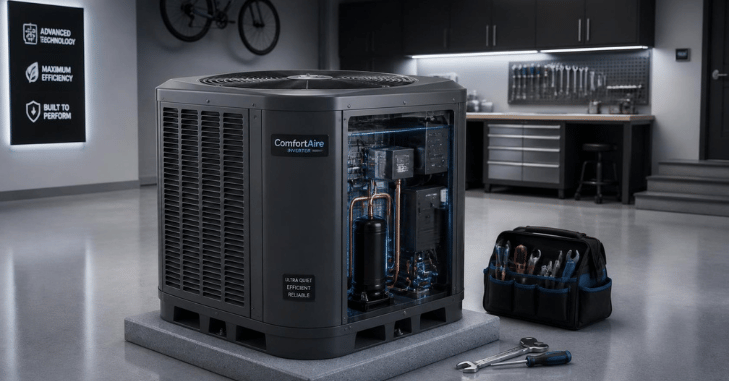
Homeowners cannot service the sealed refrigeration circuit, but routine care can reduce unnecessary strain. Change or clean the air filter according to the manufacturer’s guidance. Keep plants, stored items, and yard debris away from the outdoor cabinet to allow air to move through the coil.
Have a qualified technician inspect the system periodically. Service may include electrical testing, coil cleaning, airflow checks, temperature measurements, and verification of refrigerant performance. Avoid repeatedly lowering the thermostat when the home does not cool.
A lower setting will not repair a fault. It may keep the system operating longer and increase stress. You should also investigate sudden changes in performance. Early attention to weak cooling, short cycling, or unusual noises may prevent damage from spreading to other components.
Apart from that, if you want to know about the article How to Clean Grout Lines, then visit our Home Improvement category.
Frequently Asked Questions
Many residential models operate for about 10–15 years. Installation quality, climate, run time, airflow, electrical conditions, and maintenance can shorten or extend that period.
Continuing to operate a struggling system may increase electrical stress or damage other parts. Turn it off if it makes harsh noises, repeatedly trips the breaker, smells burned, or shows signs of leakage.
Technicians can sometimes correct related electrical, starting, or refrigerant problems. Internal mechanical damage usually requires replacement because most residential compressors are sealed units.
The fan and compressor have separate electrical components. The fan may run even when the compressor has failed to start. Low refrigerant, a control fault, or a restriction can also prevent cooling.
No. The job involves high-voltage electricity, refrigerant recovery, brazing, pressure testing, evacuation, and precise charging. Incorrect work can cause injury, equipment damage, leakage, or warranty problems.