Three contractors walk the same bathroom and hand you quotes of $4,200, $7,800, and $14,500. Nobody is lying. The spread comes from choices buried inside the bid, and once you can name them, the numbers stop feeling random.
The honest shower installation cost in 2026 runs from about $1,200 for a swapped prefab kit to $20,000 for a custom tiled wet room. Most homeowners land between $4,000 and $9,000.
Direct answer: A new shower typically costs $4,000 to $9,000 installed. Drop a prefab alcove kit into existing plumbing, and the range is $1,200 to $4,500. Site-built tile runs $6,000 to $15,000. Labor takes roughly half the bill, and moving the drain adds the most.
| Shower type | Installed cost | What that buys | Time on site |
| Prefab alcove kit | $1,200 to $4,500 | Molded acrylic or fiberglass unit, existing plumbing | 1 to 2 days |
| Tub-to-shower conversion | $3,000 to $12,000 | Tub removal, new pan, wall finish, new valve | 3 to 7 days |
| Site-built tile shower | $6,000 to $15,000 | Custom pan, waterproofing, tile, glass | 1 to 3 weeks |
| Curbless walk-in | $8,000 to $18,000 | Recessed floor framing, linear drain, tile, glass | 2 to 4 weeks |
| Wet room | $6,000 to $20,000 | Whole room waterproofed and sloped | 3 to 6 weeks |
Key takeaways
- Labor, not tile, is the biggest line on almost every shower bid.
- Keeping the drain and supply lines where they are can save $1,500 or more.
- A prefab kit and a tile shower can differ by $10,000 in the same footprint.
- Waterproofing is invisible, cheap to skimp on, and the failure that costs the most later.
- Permits run $100 to $1,000 and are usually pulled by the contractor.
- Realistic do-it-yourself savings are 30% to 45%, not the 70% people expect.
What you are paying for

Your shower quote is not one price. It is eight or nine trades stacked on top of each other, and the finish materials you shop for are often the smallest slice of it.
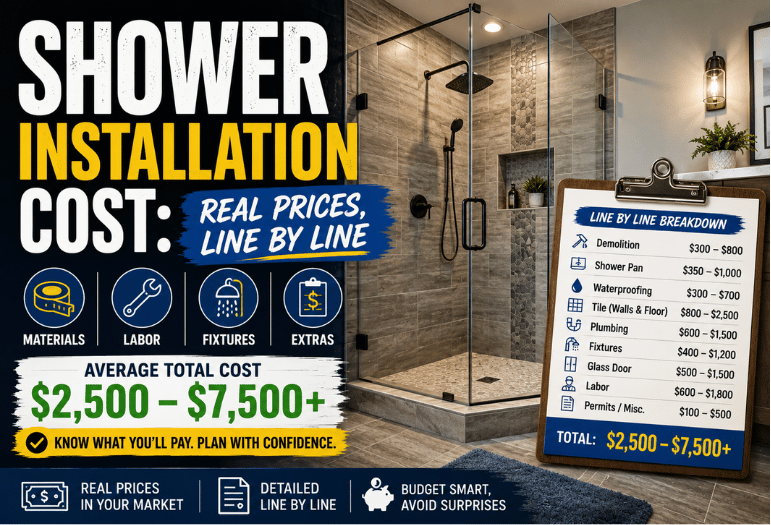
| Line item | Typical range | Notes |
| Demolition and haul-away | $400 to $1,800 | Higher on a second floor or with a cast iron tub |
| Plumbing rough-in | $850 to $1,200 | Doubles if the drain moves |
| Shower valve and trim | $225 to $1,200 | Thermostatic and multi-outlet valves sit at the top |
| Shower pan | $800 to $3,000 | Prefab base at the low end, mudded custom pan at the high end |
| Backer board and waterproofing | $800 to $1,500 | Membrane, seams, corners, curb |
| Tile and setting | $12 to $30 per sq ft | Natural stone runs $20 to $50 per sq ft |
| Glass enclosure | $400 to $3,500 | Framed at the bottom, frameless and neo-angle at the top |
| Exhaust fan | $250 to $950 | Often required by code on a new install |
| Permit and inspection | $100 to $1,000 | Varies enormously by city |
Labor sits on top of all of it. The US Bureau of Labor Statistics puts the median annual wage for plumbers, pipefitters, and steamfitters at $62,970 in May 2024, which works out to $30.27 an hour. Your invoice will say $90 to $200 an hour instead. That gap covers insurance, trucks, licensing and warranty. So a low hourly rate on a bid tells you little on its own.
If the shower is one piece of a larger job, price it inside the whole scope rather than alone. Our practical planning guide for a remodel walks through building a budget and checking permit rules before demolition starts.
Shower installation cost by type and size

Type drives the number more than anything else you choose.
Prefab alcove kit
Drop a one-piece or three-piece acrylic unit into a standard 60 by 32-inch alcove, and you have the cheapest real shower money buys. Budget $500 to $1,600 for the unit and $700 to $2,900 for installation. It goes in fast because there is nothing to waterproof by hand.
Size is the catch. Prefab means standard, so an odd alcove pushes you back toward tile.
Tile shower built in place
Here you pay for hours. Tilers charge $10 to $25 per square foot to set, and a 36-square-foot surround holds 60 to 100 pieces of trim, cuts, and inside corners. Small mosaic and herringbone patterns can double the setting time on the same square footage. There is more on this in Attic Remodel.
Tile also carries a running cost. Grout stains, absorbs, and eventually needs sealing, and keeping grout lines clean is a chore that a molded acrylic panel simply does not have.
Walk-in and curbless
Walk-ins with a low curb cost a little more than a standard tile shower. Curbless is a different job. The subfloor has to drop, which means cutting or sistering joists, and a linear drain and sloped mortar bed replace the simple center drain.
Expect $1,500 to $4,000 on top of the tile shower price for that work alone.
Size it properly if accessibility is the point. Section 608 of the 2010 ADA Standards, published by the US Access Board, sets a transfer-type shower compartment at 36 inches by 36 inches. That is an absolute dimension, not a minimum. Standard roll-in compartments measure at least 60 inches wide by 30 inches deep. Homes are not bound by the ADA, but those numbers are what a wheelchair needs.
Tub-to-shower conversion
Pulling a tub and putting a shower in its place is the most common version of this project. Swap straight into a prefab base, and you are at $3,000 to $5,500. Go to tile with a frameless door, and you are at $8,000 to $12,000.
One warning worth the paragraph: converting the only tub in a one-bathroom house can hurt resale in family neighborhoods. Buyers with small children look for a tub.
Wet room
A wet room waterproofs and slopes the entire floor, so the shower has no enclosure at all. Contractors price these by the room rather than by the fixture, around $175 to $600 per square foot, with $225 a common midpoint. So a small 40-square-foot bathroom lands near $9,000, and a generous one can pass $20,000.
What pushes the number up
- Moving the drain. The single biggest swing. Relocating a drain and supply lines adds $500 to $2,500, more on a concrete slab where the floor has to be cut and patched.
- Going curbless. Structural framing work, not a finish upgrade.
- Custom glass. Frameless panels are measured after tile is set, tempered to order, and run $1,000 to $3,500 installed.
- Stone and large-format tile. Marble needs sealing, heavy slabs need two people, and a 24 by 48 inch tile needs a floor flatter than most walls are.
- What is behind the wall. Rotten studs, old galvanized pipe, or a failed pan show up on day one of demolition and rarely cost less than $800 to put right.
Permits, inspections and code

Swapping a showerhead or a valve trim needs no permit anywhere. Once you open a wall, move a drain, or add a circuit for a fan, most jurisdictions want one. Fees run $100 to $1,000 depending on the city and whether plumbing and electrical are pulled separately.
Skipping the permit is a false economy. An unpermitted bathroom shows up during a sale, and the buyer’s agent will ask for a price cut or a retroactive permit that costs more than the original.
Doing it yourself: where the savings are real
Labor is half the bill, so the temptation is obvious. Those savings are real but smaller than most people assume, because the tasks a homeowner can safely take on are the cheap ones.
| Task | DIY savings | Verdict |
| Demolition and haul-away | $400 to $1,500 | Best value. Slow, dirty, low risk |
| Painting and trim after | $200 to $600 | Worth doing yourself |
| Fixture and trim install | $150 to $400 | Fine with basic tools |
| Tile setting | $1,000 to $3,000 | Only if you have tiled before |
| Waterproofing the pan | $500 to $1,200 | Hire it out. A leak here rots the framing |
| Valve and drain plumbing | $800 to $1,500 | Licensed plumber, and often required by code |
Swapping in a full prefab kit is a genuine weekend job for a confident homeowner, and a tile shower is not. Before you touch anything, find the supply stops and test them. A seized or leaking shut off valve turns a simple demolition day into an emergency call.
Reading two bids side by side
Ask every bidder for the same six numbers. Any bid that will not break down is one you cannot compare.
- Is the drain staying put, and what does it cost if it moves?
- Which waterproofing system, by brand, and is the warranty in writing?
- Pan type: prefab base, or mortar bed built on site?
- Who supplies the tile, and what allowance per square foot is in the price?
- Is the glass in the bid, or a separate order after tile?
- Who pulls the permit, and is the fee included?
What the shower costs after it is in
The fixture you pick has a bill attached long after the truck leaves. Federal rules cap showerheads at 2.5 gallons per minute. The US Environmental Protection Agency reports that a WaterSense labeled model uses no more than 2.0 gpm. That saves the average family 2,700 gallons of water and roughly 330 kilowatt hours of electricity a year.
Ventilation is the other running cost, and it is cheap. An exhaust fan that clears the room stops the damp that produces the pink film in a shower and protects the caulk you just paid for.
Stone owners have one more line item. Marble and granite need periodic sealing. Budget an hour and the price of a bottle once a year, and pick the right granite sealer before the first coat.
Your next step
Measure your alcove, decide whether the drain moves, and then get three written bids using the six questions above. That one decision, drain stays or drain moves, will tell you more about your final price than any tile you pick.
Frequently asked questions
Most homeowners pay $4,000 to $9,000 for a new shower installed. Simple prefab replacements start near $1,200, and custom tiled walk-ins with frameless glass reach $15,000 to $20,000.
Prefab swaps take one to two days. A tile shower takes one to three weeks, because mortar, membrane, thinset, and grout each need curing time between visits.
Buying and setting a basic tub costs less than building a tile shower. Once you add a tiled surround and a glass door, the shower costs more than the tub.
Replacing a unit in the same footprint often does not need one. Moving plumbing, altering framing, or adding electrical work almost always does. Call your local building department before demolition day.
A midrange bathroom update generally returns a large share of its cost at resale, and a dated or leaking shower is a visible defect buyers price against you. Spending $18,000 on a wet room in a modest house will not come back.
Keep the plumbing where it is, buy a prefab acrylic kit, do the demolition yourself, and hire out only the plumbing and the set. That combination reliably lands under $2,500.