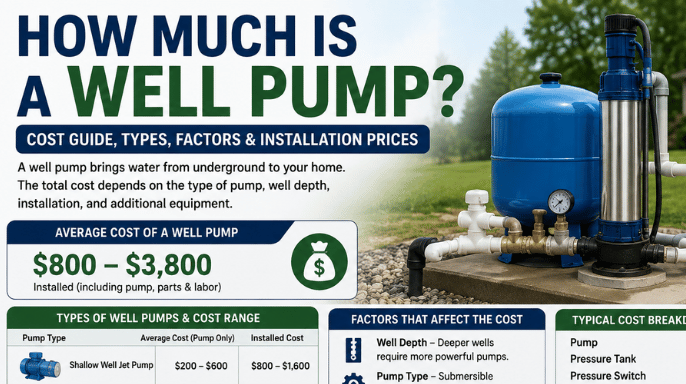
The answer to how much is a well pump splits in two, and the halves sit a long way apart. The unit by itself runs $110 to $700 on a big-box shelf. Getting one down the casing and running costs most homeowners $1,000 to $2,800. Keeping those two figures separate is the whole trick to reading a quote.
Replacements nationally average close to $1,900, and the usual band runs $977 to $2,827. Swap a shallow jet on a 20-foot bore, and you can finish under $800. Go to 400 feet with fresh pipe and wire, and the bill can pass $5,000. Depth, pump style, and how fast you need water back decide where you land inside that spread.
| Pump type | Depth it suits | Pump unit alone | Installed, all in |
| Shallow well jet | Up to 25 feet | $110 to $650 | $400 to $1,800 |
| Convertible or deep well jet | 25 to 110 feet | $260 to $1,500 | $800 to $2,500 |
| Submersible, 4 inch | 25 to 400+ feet | $140 to $1,500 | $1,000 to $3,000 |
| Constant pressure, VFD | Any depth | $1,000 to $3,000 | $1,300 to $5,000 |
| Hand pump | Up to 300 feet | $150 to $1,450 | $200 to $2,000 |
| Solar submersible | Off-grid, any depth | $800 to $4,400 | $1,800 to $6,500 |
Key Takeaways Before You Call Anyone
- The pump is rarely half the bill. Labor, pipe,and wire usually cost more than the motor.
- Depth drives everything. Roughly $500 to $1,000 gets added for each extra 100 feet.
- A $25 pressure switch fails far more often than a $600 motor does.
- Saturday and holiday calls carry a 25% to 50% labor premium.
- Where you live swings the total by a third in either direction.
- Budget for water testing after the job, not just for the hardware.
How Much Is a Well Pump By Type, Unit Price Against Installed Price?
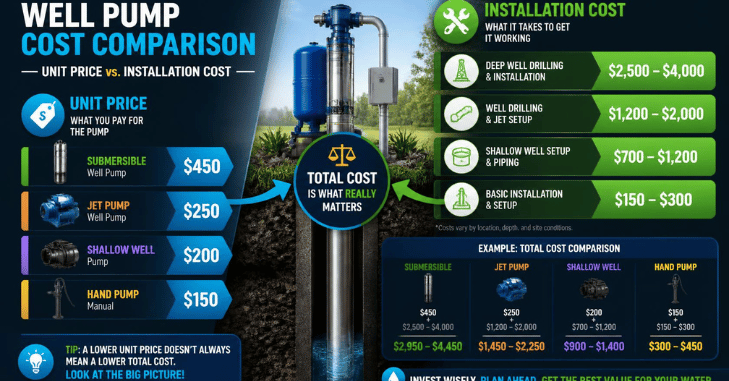
How Much Is a Well Pump?? Every pump style below moves water a different way, and each one suits a different bore. Retail prices here come from current August 2026 listings at national home centers. Installed figures blend published contractor ranges for a straight swap. For a closer look at this, see Shower Installation Cost.
Shallow well Jet Pumps
A shallow jet sits above ground, usually in a basement or a small pump house, and sucks water up a single pipe. Physics caps that suction near 25 feet. Retail runs from about $110 for a plastic-housing half-horsepower unit to $650 for a cast iron 1 HP model from a name like Myers.
Fitted, expect $400 to $1,800. Nothing has to come out of the ground, which is why this is the cheapest job on the page. No rig. No 200-foot string of pipe laid out across your lawn.
Convertible and Deep well jet Pumps
A convertible jet is the quiet bargain of the category. One machine covers both shallow and deep well work: you move the ejector to change its role. An ECO-FLO 1 HP convertible lists at $258.63 and carries a 90-foot maximum. Everbilt’s equivalent runs $609. Contractor-grade units reach $1,500.
Installed, plan on $800 to $2,500. Two pipes go down the bore instead of one, so the pipe bill roughly doubles and the fittings list grows with it. Ask whether the quote covers both runs of pipe.
Submersible Pumps
This is what sits in most drilled wells in the country. The motor lives underwater at the bottom of the casing and pushes rather than pulls, which is why it handles 400 feet without complaint. Budget imports start near $140. Everbilt sits at $479 for a half-horsepower unit and $689 for a 1 HP, 20 GPM model. Grundfos and Franklin Electric commonly add $400 to $600 on top.
Installed cost lands between $1,000 and $3,000 for a typical 100 to 200 foot well. If you have already priced what a sump pump costs to install, the two jobs are nothing alike. That one sits in an open pit you can reach with one hand.
Constant pressure, solar and hand pumps
Constant pressure systems put a variable speed drive on the motor so shower pressure holds steady while the washer fills. They run $1,300 to $5,000 fitted. Solar setups for off-grid sites cost $1,800 to $6,500. Hand pumps, kept as a backup or fitted at a cabin, cost $200 to $2,000.
What you Actually Pay for Besides the Pump?

Here is where a quote grows past the number you saw online. Everything on this list is priced by the foot or by the hour, which is why two neighbors get different totals.
| Line item | 2026 price |
| Drop pipe | $1 to $3 per foot |
| Submersible wire | $1.50 to $2.50 per foot |
| Pitless adapter | $100 to $300 |
| Check valve and torque arrestor | $50 to $200 |
| Control box, 3-wire pumps | $100 to $400 |
| Pressure switch | $25 to $100 |
| Pressure tank, fitted | $300 to $1,000 |
| Labor | $45 to $150 per hour |
| Call-out fee | $100 to $150 |
| Hoist rig, deep wells | $300 to $700 |
| Permit | $25 to $500 |
Run the arithmetic on a 250-foot bore. Pipe at $2 a foot is $500. Wire at $2 a foot is another $500. That is $1,000 in consumables before anyone touches the pump or the labor line, and it is the single biggest reason deep wells cost what they do.
How Well Does Depth Change ththe Number
Depth does not add cost in a straight line. It compounds. Set the pump deeper, and it needs more horsepower, more pipe, more wire, a bigger truck, and more hours.
Well contractors use a rough planning rule: add $500 to $1,000 for every extra 100 feet. Under 100 feet, most jobs finish in three to six hours. Past 300 feet, a hoist rig usually shows up, and the day stops being a plumbing visit.
Where You Live Swings the Price by a Third?
Regional labor rates move these totals more than brand choice does. Against the national average, published contractor data puts the regional swing at roughly these levels.
- Midwest: 10% to 15% below
- Southeast: at or slightly below
- Mid-Atlantic: at or slightly above
- Mountain West: 10% to 20% above
- Northeast: 15% to 30% above
- Pacific Northwest: 20% to 35% above
- California: 25% to 40% above
So a $1,900 national figure is really $1,650 in Iowa and $2,600 in coastal California for identical work with an identical pump.
Same job. Different zip code.
When The Pump is Not The Problem At All

No water at the tap does not prove the motor died. Several cheap parts fail in ways that mimic a dead pump, and a good technician rules them out before quoting four figures.
- Pressure switch, $50 to $300 fitted, the most common culprit by a wide margin
- Control box or start capacitor on a 3-wire setup, $150 to $600
- Check valve, $100 to $350
- Waterlogged pressure tank, $600 to $2,500, which makes the pump short cycle itself to death
Plumbing further downstream fools people too. A leaking water shut-off valve can bleed pressure all night and leave you convinced the pump has quit. Ask first. Get the diagnostic result in plain language before you approve any replacement, and ask which of those four parts the technician checked.
Repair, Replace, or Live With it a While
Well pumps last 8 to 15 years.
A motor at year twelve is not worth a $600 rebuild when the replacement costs $700 and comes with a warranty. One at year four probably is.
It is the same math homeowners run on an AC compressor replacement cost: if the repair takes a big share of a full replacement, replace. And if the crew is pulling 250 feet of pipe anyway, fit the new pipe, wire,, and check valve while everything is above ground. Doing it twice doubles the labor.
The Line Nobody Quotes: Your Drinking Water
This is the part that separates a well from any other home system. The EPA estimates that more than 23 million households rely on private wells for drinking water in the United States. Its private well guidance puts responsibility for that water squarely on the owner. No utility is checking it for you.
Pulling a pump opens the casing and lays hundreds of feet of pipe across your yard. Reputable drillers chlorinate the well before they close it up. Ask whether disinfection is in the quote, because it is often assumed rather than written down.
Then retest. EPA guidance recommends testing a private well every 12 months for total coliform bacteria, nitrates, total dissolved soli,,ds and pH. Run that test again after the work, not a year later. Lab panels start near $30 and top out around $150, small against a $2,000 job.
How to Compare Well Pump Quotes WithGuessingsing?

Quotes vary wildly because contractors quote different scopes, not because one is cheating you. Make them quote the same thing.
- Ask what failed and how they proved it.
- Get the pump make, model, and horsepower in writing.
- Ask whether new drop pipe and wire are in the price or extra.
- Confirm who pays for the permit.
- Ask if chlorination and a water test are included.
- Check the warranty on parts and on labor separately.
One more thing worth knowing: emergency and weekend work adds 25% to 50% to the labor line. If you have a spare tank of water and a neighbor with a hose, waiting until Monday is often worth a few hundred dollars.
Your Next Step
How Much Is a Well Pump? Get three itemized quotes, and hand each contractor the same six questions from the list above. Ask them to price the pump, the pipe, the wire, the labor, and the water test as separate lines. The cheapest headline number rarely stays cheapest once the scopes match up, and a written scope is what protects you when the truck is already parked in the driveway.
Your next step
Get three itemized quotes, and hand each contractor the same six questions from the list above. Ask them to price the pump, the pipe, the wire, the labor, and the water test as separate lines. The cheapest headline number rarely stays cheapest once the scopes match up, and a written scope is what protects you when the truck is already parked in the driveway.
Frequently Asked Questions
Between $110 and $700 covers most residential models at national retailers, and premium submersibles from Grundfos or Franklin Electric reach $1,500. That price excludes the pipe, the wire, the fittings, and the labor, which together usually exceed the pump itself.
Eight to fifteen years is the normal service life. Sand in the water, frequent short cycling, and an undersized pressure tank all shorten it.
Swapping a shallow jet in a basement is within reach of a confident DIYer. Pulling a submersible from 200 feet is not. The string of pipe weighs hundreds of pounds, and the wiring is 230 volts. Drop the assembly down the bore and a $2,000 job becomes a $10,000 one.
Depth, region, and access explain nearly all of it. Set a 350-foot well in Oregon against a 90-foot well in Missouri. Totals differ by thousands, with the same pump in both.
If the tank is over ten years old or feels heavy when you rock it, yes. Fitting it during the same visit costs $300 to $1,000 instead of another full call-out later.