
Some foundation settlement is expected. Almost every house sinks slightly into the ground during its first year or two, and an even, gradual drop of an inch or so rarely causes damage. Trouble starts when one part of the house sinks faster than the rest. That unevenness, not the total distance, is what cracks walls and jams doors.
Normal or a Problem? Read the Pattern
| What you see | What it usually means | What to do |
| Whole house dropped evenly, no new cracks | Uniform compaction, the harmless kind | Nothing |
| Hairline cracks in year one or two of a new build | Curing concrete plus initial soil compression | Photograph and date them |
| Floors slope toward one corner | Uneven drop under part of the footing | Get elevations measured |
| Doors bind on one side of the house only | Differential movement, active | Call an engineer |
| Stair-step cracks widening month to month | Soil still failing under that corner | Engineer now, before quotes |
| Gaps opening between wall and ceiling | Advanced structural distortion | Engineer immediately |
TL;DR
- Even sinking is survivable. Uneven sinking is the expensive kind.
- New builds move most in the first 24 months, then slow sharply.
- Water in the soil drives almost all of it. Clay swells wet and shrinks dry.
- A floor elevation reading beats guessing from crack width.
- An independent engineer costs $500 to $3,000 and saves far more than that on quotes.
Uniform vs Differential: the Distinction That Decides Everything
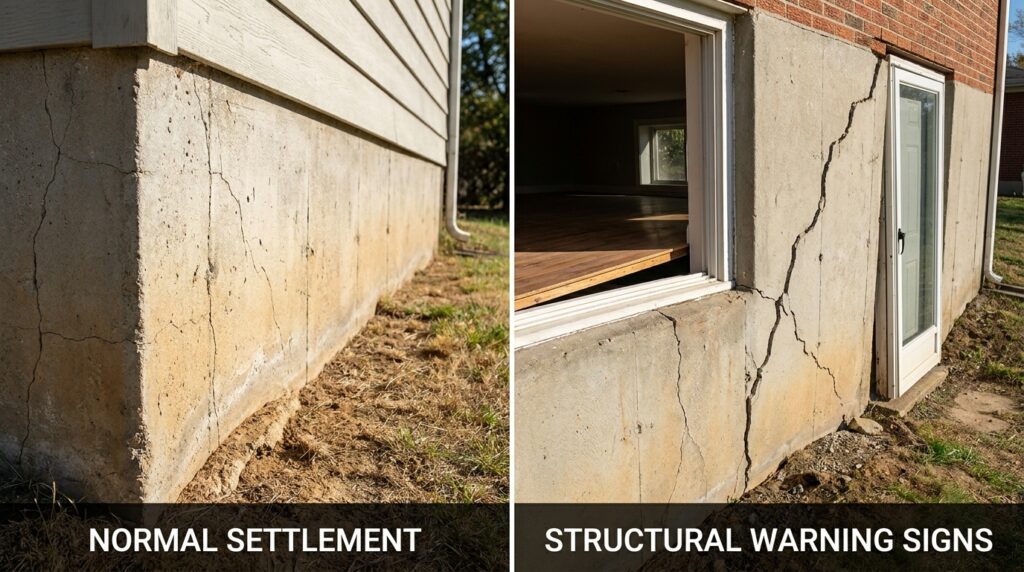
A house that sinks two inches straight down, all four corners together, usually shows nothing. Every part of the structure moved as one, so nothing twisted.
Now drop one corner half an inch while the rest holds still. The frame has to bend to follow. Drywall tears at its weakest points, which is why cracks start at window and door corners.
Half an inch of unevenness causes more damage than two inches of even movement. Guides that quote a single “acceptable” number miss this entirely.
Crack width is a symptom of the twist, not a measure of the drop. Our guide to cracked foundation warning signs covers how to read them, including the direction rules that matter more than length.
How Long a New Build Keeps Moving
Backfilled soil around a new foundation is loose. It compresses under load, and most of that compression happens early. Expect the bulk of it inside 24 months. Hairline cracks in that window are common and usually stop on their own.
After year three, fresh movement means something changed. A leak, a drought, a new tree, a regraded yard, a neighbor’s excavation. New movement in an old house has a cause worth finding.
What Actually Makes the Ground Give Way

Water changes soil volume, and soil volume changes what your footings rest on. That is the whole mechanism. Expansive clay is the worst offender. It swells when it soaks and shrinks when it bakes, so a wet spring after a dry summer works your footings like a slow jack.
According to the Virginia Department of Energy, US losses from these soils are estimated at about $7 billion a year. Department of Agriculture data from the same page puts roughly 50% of American homes on soil that swells.
Which means this is not a rare defect. It is a common condition most houses live with quietly.
Four other causes show up repeatedly:
- Poor compaction at construction. Fill that was never properly tamped keeps compressing for years.
- Drainage aimed at the house. Downspouts dumping at the wall, or a yard that slopes inward, soak one zone repeatedly.
- Leaks below grade. A cracked sewer lateral or a slab leak washes soil out from under the footing where nobody can see it.
- Thirsty trees. Large roots pull moisture out of clay in a dry season, shrinking the soil on one side only.
The water fix is nearly always cheaper than the structural one. Correcting grade and extending downspouts runs a few hundred dollars, and a sump pump installation at $800 to $2,500 is small next to underpinning.
Measure the Drop Before Anyone Sells You Anything
Contractors bring a laser and a bid. You can get the first half yourself in an afternoon.
- Pick a long, uninterrupted run of floor, ideally corner to corner across the main level.
- Set a 4-foot level on the floor and shim one end until the bubble centers. Measure the shim height.
- Repeat every four feet along the run, adding the shim heights as you go. That total is your drop across the span.
- Roll a marble at each end to confirm the direction. It runs toward the low corner.
- Write down the numbers and the date, then repeat in three months.
Two readings months apart tell you the thing no single measurement can: whether the house is still moving. A static drop is history. Growth means the problem is live.
A professional elevation survey does the same job with a manometer or laser and prints a contour of your whole floor. That document is what an engineer reads, and it is what separates a real diagnosis from a sales pitch.
Signs That Move It From Watch to Call
Any one of these on its own means keep an eye on it. Two or more together justify a phone call.
- Doors and windows that stick on one side of the house but not the other
- Diagonal cracks running out from door and window corners
- Stair-step cracks through block or brick mortar joints
- Floors that visibly slope, or a marble that always runs the same way
- Gaps opening where walls meet ceilings or where trim meets floors
- Exterior brick separating from window frames
- A chimney tilting away from the wall
Doors are the most useful early warning in the list. They bind long before drywall cracks, because a door frame is tuned to a sixteenth of an inch.
When Foundation Settlement Needs Repair
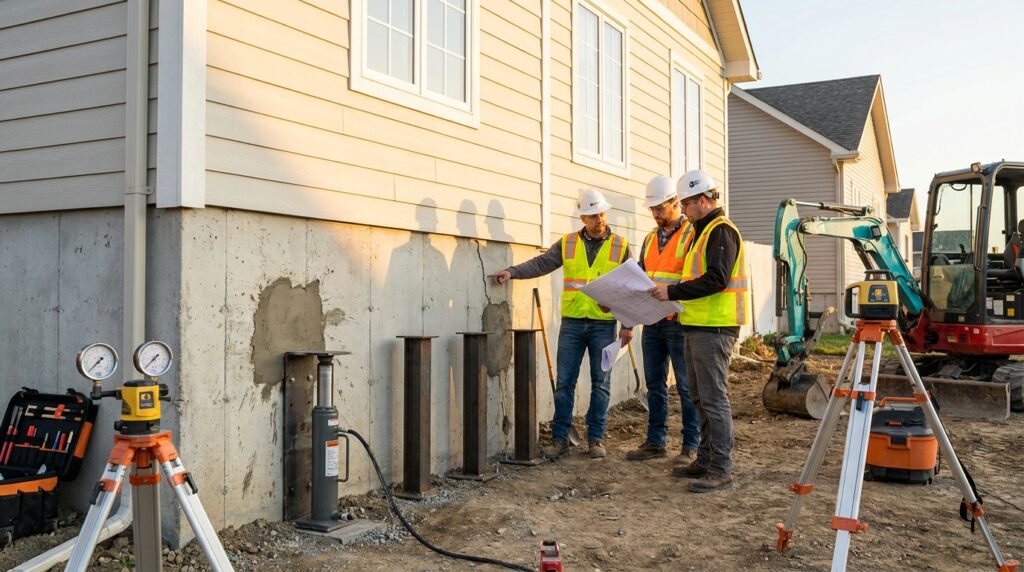
Three conditions push a house from monitoring into fixing. Movement is still active. Your own measurements, taken months apart, show the drop growing. Nothing you patch will hold while the soil keeps failing.
The distortion is structural rather than cosmetic. Floors slope enough to feel underfoot, doors will not latch, and cracks run diagonally through more than one wall.
The cause will not stop by itself. Expansive clay under a house with no drainage correction keeps cycling every season, and every season the numbers get worse.
Underpinning with piers is the answer when a footing has genuinely dropped. Slab lifting and wall bracing solve different failures and do nothing for a sinking footing, which is why bids vary so wildly. Our breakdown of repair methods compared by cost and fit matches each method to the failure it actually addresses.
What It Costs to Find Out
| Step | Typical 2026 price | What you get |
| Your own level readings | $0 | Direction and rough size of the drop |
| Contractor “free inspection” | $0 | An opinion from someone selling the cure |
| Structural engineer report | $500 to $3,000 | Independent scope three bidders can price |
| Soil report, where required | $500 to $3,000 | What the ground under you is doing |
Pay for the engineer first. An independent sealed scope is the only document that makes three quotes comparable, and it removes the incentive problem baked into a free inspection.
Your Next Step
Take level readings across your main floor this week and write down the date. Check the same run in three months. If the number grew, book an independent structural engineer before you let a single repair company through the door. That order, measurement first and salespeople second, is what keeps a monitoring job from being sold to you as a $20,000 one.
Frequently Asked Questions
Almost never. Standard policies exclude earth movement and gradual deterioration. A sudden covered event, such as a burst supply line washing soil out, is sometimes an exception, so read your exclusions before filing.
There is no single number, because unevenness matters more than depth. As a working rule, a visible floor slope plus doors binding on one side warrants a professional look.
Often, yes. Initial compaction under a new build usually finishes within two years. Clay-driven movement, by contrast, cycles indefinitely until the drainage changes.
Yes, and most states require you to disclose it. A signed engineer’s letter describing the current condition protects the sale far better than a fresh coat of paint.
Usually. Concrete shrinks as it cures, and backfill compresses under load. Photograph them with the date, then check again in six months.
Mature trees close to a house can pull enough moisture from clay to shrink the soil on one side during a dry spell. Removing one abruptly can cause the reverse, since the soil rebounds.