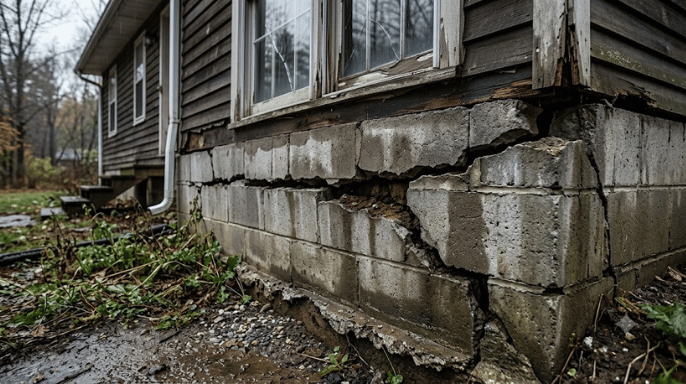
A cracked foundation is not automatically a five-figure emergency. Most concrete splits a little in its first two years while the mix cures and the ground shifts underneath. What matters is the width, the direction, and whether the gap is still opening. This guide shows you how to separate a cosmetic hairline from real structural trouble, what each repair costs, and who to call first.
Crack Types at a Glance
Start with the shape. Good contractors read a basement wall the way a radiologist reads a scan, and the pattern says far more than the length does.
| Crack pattern | What it usually means | How fast to act | Typical 2026 repair |
| Hairline vertical, under 1/8 inch | Concrete shrinking as it cured | Watch it | $0 to $250 in sealant |
| Vertical, 1/8 to 1/4 inch, damp edges | Minor settling plus water entry | This season | $250 to $800 injection |
| Diagonal from a window or door corner | One corner dropping faster than the rest | Get it measured | $500 to $3,000 engineer report |
| Stair step through block joints | Uneven settlement or side pressure | Within a month | $900 to $2,000 carbon fiber |
| Horizontal along a block wall | Wet soil pushing the wall inward | Now | $500 to $3,000 per anchor |
| Wide gap with a bowed or shifted wall | Structural failure already underway | Immediately | $10,000 to $30,000 underpinning |
Key Takeaways
- Direction beats length. A long vertical hairline is usually harmless; a short horizontal one rarely is.
- Four stacked quarters measure about 1/4 inch. That thickness is the rough line where most engineers want a look.
- Cracks that have stopped moving are a sealing job. Cracks that are still growing are a soil job.
- Water causes most of it. Fix the drainage, or the repair will fail again.
- Standard homeowners policies exclude earth movement and gradual settling, so most claims fail.
When a Cracked Foundation Is Actually Serious

Most gaps under 1/8 inch that run straight up and down are shrinkage, and a tube of sealant handles them. Worry when a crack runs sideways, steps diagonally through block joints, opens wider than 1/4 inch, or keeps growing. Those patterns point to soil pressure or real movement under the footing.
Seven signs move a crack from the watch list to the call list.
- It runs horizontally along the wall.
- It stair steps through the mortar joints.
- One end is noticeably wider than the other.
- The gap exceeds 1/4 inch at any point.
- It weeps or leaks after heavy rain.
- The whole thing appeared over weeks rather than years.
- Doors or windows nearby have started to stick.
One sign alone is worth a note in your phone. Two together are worth a professional opinion.
Measure It Before You Panic
Guesswork is what turns a $300 problem into a $3,000 quote. You already own everything you need to size the gap properly.
- A credit card is roughly 1/32 inch thick. If it will not slide in, you are looking at a true hairline.
- Use a quarter’s edge, about 1/16 inch, to size up a medium gap.
- Stack four quarters and you have about 1/4 inch. If the crack takes that stack, stop measuring and start calling.
- Photograph the widest point with a tape measure held flat against the wall in the same frame.
Write the date on the photo. You will want it later.
The 30 Day Test That Shows If It Is Still Moving
An active crack and a dormant one look identical on any given Tuesday. Telling them apart is free and takes a month.
- Draw a short pencil line across the crack at its widest point.
- Write today’s date beside the line, then measure the gap and write that down too.
- Mark each end of the crack with a small pencil tick so you can see if it lengthens.
- Photograph the whole thing, including the date.
- Repeat on the same day next month, and again after the first heavy rain.
No change after 30 days across a wet spell? The concrete has settled, and a sealant will hold. Growth of even 1/16 inch means something below is still moving, and no patch will outlast it.
How Common Is This, Really?
Homeowners tend to assume they are the unlucky one. National data says otherwise. The 2023 American Housing Survey, run by the US Census Bureau with HUD, counted 4.9 million occupied homes with crumbling or open cracks in the base. Nationwide, there are 133.2 million occupied units, so that is roughly one home in 27.
So a cracked slab is common. Catastrophic damage is not. The gap between those two facts is exactly why measuring beats panicking.
What Pushes Concrete Apart
Almost every structural crack traces back to water changing the volume of the soil around your footings. Expansive clay swells when it soaks and shrinks when it bakes, and the wall rides that movement up and down for years.
Indoor leaks do the same job more quietly. A slow drip under a slab saturates the ground from the inside. Left alone, a leaking water shut-off valve can soak one corner for months before anyone hears it. Check your meter with every tap closed.
Buried drain lines deserve the same suspicion. A cracked lateral dumps gallons into the soil directly beneath the house, which is why a camera sewer inspection often explains a crack that no one can otherwise account for.
Then there is groundwater. Where the water table sits high, hydrostatic pressure pushes on the outside of a block wall until it bows, and the usual answer is drainage rather than concrete. Comparing sump pump installation costs is often cheaper than a second round of wall repair.
Repair Methods and What They Cost

Page one tends to quote one alarming range and leave it there. Here is the 2026 market broken out by method, so you can see which quote belongs to your problem.
| Method | What it fixes | Typical cost |
| Epoxy or polyurethane injection | Non-moving cracks and water entry | $250 to $800 per crack |
| Carbon fiber straps | Block walls beginning to bow | $900 to $2,000 per crack |
| Wall anchors | Walls already pushed inward | $500 to $1,000 each |
| Helical tiebacks | Heavy lateral soil pressure | $1,000 to $3,000 each |
| Piers or underpinning | Settlement, one side dropping | $2,000 to $30,000 |
| Structural engineer report | Diagnosis and a repair scope | $500 to $3,000 |
Epoxy suits a gap that has stopped moving; polyurethane flexes, so it suits one that opens and closes through freeze and thaw. If the work will run alongside other projects, fold it into a single scope early using a remodeling budget planning guide rather than treating it as a surprise line item.
Will Homeowners Insurance Pay?
Usually not, and the reason catches people out. Standard policies pay for sudden accidental losses, not for slow deterioration, so the exclusions that matter here are earth movement, settling, and lack of maintenance.
- Covered more often: a burst supply pipe, a vehicle strike, an explosion, or fire damage.
- Excluded almost always: expansive clay, gradual settling, tree roots, poor drainage, flood.
- Worth asking about: a separate earthquake endorsement, and water backup coverage.
Ask your insurer for the exclusion wording in writing before you file anything. Denied claims stay on your record, and they are not free.
Selling a House With a Damaged Base
Most states require you to disclose known material defects, and a repaired crack is still a known defect. Hiding it invites a lawsuit after closing that costs far more than the repair did. Before you list, ask a real estate attorney what your state’s disclosure form demands.
One document changes the conversation: a signed engineer’s letter confirming the repair and the current condition. Buyers who see paperwork negotiate. Buyers who see a patch and a shrug walk away.
Contractor or Structural Engineer?
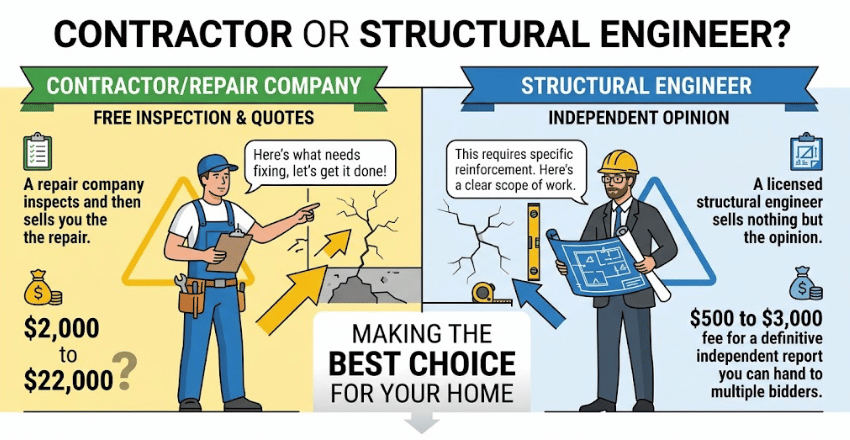
The free inspection is free for a reason. A repair company inspects and then sells you the repair. That is not fraud, but it is a conflict of interest. It also explains how two firms can quote $2,000 and $22,000 for the same wall. A licensed structural engineer sells nothing but the opinion. For $500 to $3,000, you get an independent scope you can hand to three bidders. On a serious wall, that fee usually pays for itself on the first quote.
Your Next Step
Measure the widest point today, photograph it with a tape measure and the date, and mark both ends in pencil. Check it again in 30 days. If it grew, or if it runs sideways, book an independent structural engineer before you call a single repair company. That order, measurement first and salespeople second, is what keeps a $400 job from being sold to you as a $20,000 one.
Frequently Asked Questions
No. Sealing a dormant hairline runs $250 to $800. Thefive-figuree numbers belong to piers and underpinning, which apply to a small share of homes.
Yes, if it is under 1/8 inch, dry, vertical, and it has not moved in 30 days. Kits of hydraulic cement or polyurethane cost under $50. Clean the surface first so the material bonds.
About 1/4 inch is the common trigger for a professional look, and anything horizontal deserves one at any width.
Rarely. Sagging floors, doors that will not latch, and a wall bowing more than an inch are the signals that matter for safety.
Injection takes a few hours. Carbon fiber takes a day. Piers take a week or more, plus curing time.