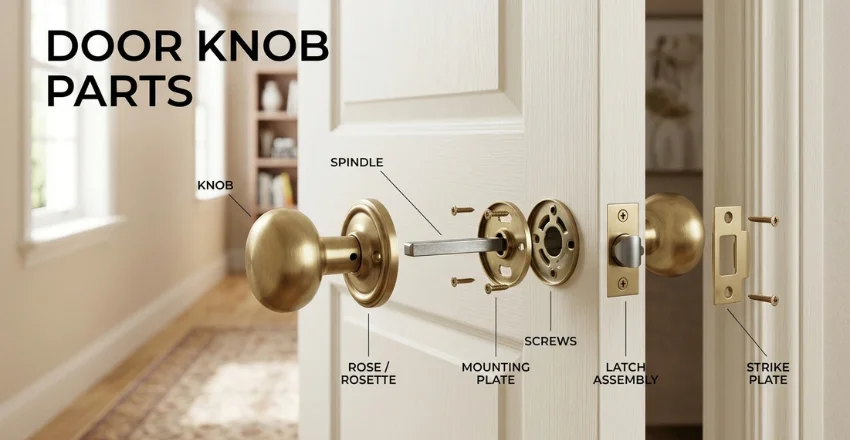
If you understand door knob parts, you can often tell whether a loose handle, sticky latch, or faulty lock needs a small repair or full replacement. Most residential locksets use a few basic components, including knobs, trim, a spindle, latch assembly, mounting hardware, and a strike on the frame.
Direct answer: A typical residential lockset includes two knobs or levers, trim roses, a spindle, a chassis, a latch assembly, a faceplate, a strike plate, mounting screws, and return springs. Locking models also add a key cylinder or privacy control. Turning the handle rotates the spindle, which retracts the latch bolt so the door can open.
| Component | Where It Is | Main Function |
|---|---|---|
| Knob or lever | Both sides of the door | Gives you a grip for operating the latch |
| Rose or escutcheon | Behind the handle | Covers the mounting hole and hardware |
| Spindle | Through the center of the lockset | Transfers handle movement to the latch |
| Chassis or hub | Inside the main bore | Supports the operating mechanism |
| Return spring | Inside the assembly | Returns the handle after it turns |
| Latch bolt | Door edge | Holds the door closed |
| Latch assembly | Inside the door edge | Retracts and extends the latch bolt |
| Faceplate | Door edge | Secures and finishes the latch opening |
| Strike plate | Door frame | Receives the latch when the door closes |
| Mounting screws | Through the lockset | Holds both sides of the assembly together |
| Lock cylinder | Exterior side of keyed models | Accepts the key and controls locking |
| Thumb turn or button | Interior side of locking models | Locks or unlocks the mechanism from inside |
TL;DR
A knob assembly is easier to diagnose once you separate the operating hardware from the locking hardware. The spindle and latch handle normal opening, while cylinders and privacy controls manage locking. Before ordering a replacement, identify the failed component and measure the existing door preparation.
Door Knob Parts: The Main Pieces and What They Do
Knob or lever
The knob is the part you grip and turn. Some locksets use a lever instead, but both perform the same basic job. Their movement activates the mechanism hidden inside the door.
A loose handle doesn’t always mean the entire assembly has failed. A worn set screw, loose mounting screw, or damaged connection to the internal hub may be responsible.
Rose, escutcheon, or backplate
The circular or rectangular trim behind the handle is commonly called a rose, rosette, escutcheon, or backplate. It covers the large bore in the door and hides mounting hardware.
This trim also gives the finished installation a clean appearance. Depending on the design, it may snap onto a separate mounting plate or be attached as part of the main assembly.
Spindle
The spindle is the metal shaft that connects the handles through the door. Turning one side rotates this shaft, transferring motion to the latch mechanism.
Schlage describes the spindle as the bar that connects knobs or levers on the door so they can operate the lock mechanism. A damaged spindle or hub can cause a handle to turn without pulling the latch back.
Chassis and internal hub
The chassis sits inside the main door bore and supports much of the operating hardware. The spindle passes through a hub within this assembly.
This area may also contain springs and other small moving pieces. Internal designs vary by brand and model, so individual chassis components aren’t always interchangeable.
Return spring
A return spring helps the handle move back to its resting position after you release it. A weak or broken spring may leave a lever sagging or a knob feeling loose.
Some manufacturers build this spring into the chassis. If the spring isn’t sold separately, replacing the larger assembly may make more sense than rebuilding it.
Latch assembly and latch bolt
The latch assembly fits into the edge of the door. Its spring-loaded bolt projects outward and enters the frame-side strike when the door closes.
Turning the handle retracts that bolt. When you release the handle, the spring pushes it outward again. A dirty, damaged, or poorly aligned latch can make the hardware feel stiff.
Faceplate
The faceplate is the small metal plate visible on the edge of the door around the latch. Screws hold it against the edge of the door.
Some replacement latches use a rectangular faceplate, while others use a rounded or drive-in design. Match the replacement style to the existing door preparation whenever possible.
Lock cylinder and privacy control
Keyed-entry models usually include a cylinder on the exterior. The cylinder contains the key-operated components that enable or prevent locking.
Bedroom and bathroom hardware may use a push button or thumb turn instead. Passage sets normally have no locking function at all.
Strike plate
The strike plate mounts to the door jamb and receives the latch bolt. Schlage defines it as the frame-mounted plate with an opening for the bolt.
A door that won’t latch may have a perfectly good latch mechanism. If the door has shifted, the bolt may be hitting the edge of the strike rather than entering the strike’s opening.
How the Mechanism Works

A standard residential lockset performs a simple sequence each time you open the door. Understanding that sequence makes troubleshooting much easier.
- You turn the handle. The knob or lever rotates the spindle running through the center of the assembly.
- The spindle moves the internal hub. That motion activates the latch mechanism installed in the door edge.
- The latch bolt retracts. Once the bolt clears the strike plate, the door can swing open.
- The mechanism resets. Releasing the handle lets the springs return the latch and handle to their normal positions.
Locking hardware adds another control to that sequence. A key cylinder, button, or thumb turn prevents the operating mechanism from working normally when the lock is engaged.
Measurements to Check Before Buying Replacement Hardware
Replacement hardware can look correct online yet fail to fit your existing door. In the U.S., three measurements deserve attention: backset, bore diameter, and door thickness.
The backset is the distance from the door edge to the center of the main bore. Schlage identifies 2-3/8 inches and 2-3/4 inches as common residential backsets. Its residential preparation guidance also calls for a 2-1/8-inch crossbore in many installations.
Many residential products are designed for doors between 1-3/8 and 1-3/4 inches thick. Kwikset and Schlage both list products or preparation specifications within that range.
These dimensions are common, not universal. Older doors, commercial hardware, specialty locks, and imported products may differ. Measure your existing setup and check the replacement manufacturer’s specifications before ordering.
Which Component Is Causing the Problem?
Start with the symptom rather than replacing hardware at random. A five-minute inspection can often narrow the problem to one area.
| Symptom | Likely Area | What to Check First |
|---|---|---|
| Handle feels loose | Mounting screws, set screw, chassis | Tighten accessible fasteners and check for excess movement |
| Handle turns, but latch stays out | Spindle, hub, latch assembly | Check whether handle movement reaches the latch |
| Latch retracts slowly | Latch assembly or internal spring | Look for dirt, binding, or visible damage |
| Door closes but won’t stay shut | Latch and strike alignment | See whether the bolt enters the strike opening |
| Key is difficult to operate | Cylinder or door alignment | Test whether the problem changes with the door open |
| Lever does not return | Return spring or chassis | Check for sagging and internal resistance |
| Door sticks even when latch works | Door or frame alignment | Inspect gaps around the door and frame |
If several doors in the same home begin to stick or rub, the hardware may not be the main cause. Door or frame movement can point to a broader building issue. Gladnota’s foundation inspection guide explains warning signs that deserve a closer look.
Can You Replace One Component Instead of the Whole Lockset?
Sometimes. Latches, strike plates, screws, and certain trim pieces are commonly replaceable if you can find compatible parts. The replacement still needs to match the original dimensions and design.
Internal springs, hubs, and chassis pieces can be harder to source individually. Manufacturers may treat the internal mechanism as a single serviceable assembly rather than several separate replacement items.
For keyed exterior hardware, replacement becomes more important after physical damage. A cracked chassis, badly damaged cylinder, or forced assembly may justify replacing the full lockset rather than reusing questionable components.
Compatibility should guide the decision. Match the brand or model where possible, then confirm backset, bore preparation, door thickness, latch style, and function before buying anything.
Basic Tools and Care
Most inspections begin with a screwdriver and tape measure. If you plan to replace the full assembly, follow the manufacturer’s installation template rather than enlarging holes by eye. Gladnota’s tool guide for homeowners can help youyou build a practical home-repair kit.
Keep exposed hardware clean with methods approved for its finish. Plated brass, chrome, stainless steel, painted finishes, and coated hardware don’t all tolerate the same cleaners or abrasives.
For stainless surfaces elsewhere in the home, Gladnota also has a stainless-steel scratch repair guide. Check your hardware manufacturer’s care directions before applying any scratch-removal method to decorative lock trim.
Identify the Problem Before You Buy
Start by watching what happens when you operate the handle with the door open. Check whether the latch retracts, whether the handle returns, and whether any trim or mounting hardware moves.
Then measure the existing door preparation before choosing a replacement. That approach helps you avoid replacing a full lockset when a compatible latch, strike, or fastener can solve the problem.
For more repair, maintenance, and DIY topics, browse Gladnota’s home-improvement guides.
Frequently Asked Questions
A latch bolt is spring-loaded and normally retracts when you turn the handle. Its angled edge allows the door to close without turning the knob.
A deadbolt is a separate locking bolt that is extended and retracted with a key or thumb turn. It isn’t the same component as the spring latch used for normal opening and closing.
Measure the backset, crossbore diameter, door thickness, and edge-bore preparation. You should also note the latch faceplate style and whether the lock is a passage, privacy, keyed-entry, or another function.
Common U.S. residential dimensions can help you shop, but the measurements on your own door should control the purchase decision.
Often, yes, if a compatible latch is available. Match its backset, faceplate, or drive-in style, and connection to the existing lockset.
If the hardware is old or the internal mechanism is also worn, a complete replacement may be more practical. Check the manufacturer’s replacement-part information before ordering.
The latch bolt enters an opening in the strike plate, which is attached to the door frame. The strike helps hold the closed door in position.
If the bolt hits the plate rather than entering the opening, check the alignment before assuming the latch is broken.
It is usually called the spindle. The spindle runs through the door, transferring thehandle’ss turning motion to the latch mechanism.
If the handle rotates without moving the latch, the spindle or its connection to the internal hub is one area to inspect.
The main components are the knob or lever, rose or escutcheon, spindle, chassis, return spring, latch assembly, latch bolt, faceplate, mounting screws, and strike plate. Locking models can also include a cylinder, keyway, privacy button, or thumb turn.