


Most American homeowners pay between $4,000 and $15,000, and the walk-in shower cost on a typical suburban bid lands closer to $7,000 to $9,500. That spread is not random. It tracks whether the drain stays put, whether the walls get tile or a molded panel, and how much glass you ask for.
Short answer: a prefab kit dropped into an existing alcove runs $3,500 to $7,000 installed. A tiled shower with a semi-frameless door runs $8,000 to $13,000. A custom curbless build with a moved drain and frameless glass starts near $14,000 and climbs from there.
| Build type | 2026 installed price | What that buys | Days on site |
| Prefab kit swap | $3,500 to $7,000 | Acrylic or fiberglass pan and wall panels, same drain, framed door | 1 to 3 |
| Midrange tiled | $8,000 to $13,000 | Porcelain tile, sloped mortar pan, niche, semi-frameless glass | 7 to 14 |
| Custom curbless | $14,000 to $20,000+ | Recessed floor, linear drain, bench, frameless enclosure, stone | 14 to 25 |
| Tub to shower conversion | $2,000 to $12,000 | Tub removal, drain rework, new surround, average near $7,000 | 3 to 12 |
Key Takeaways
- Labor is roughly half of a tiled job, so local wage rates move the total more than tile choice does.
- Ask for the bid split into demolition, rough plumbing, waterproofing, tile, glass and fixtures.
- Curbless looks like a $500 upgrade and behaves like a $3,000 one once framing is involved.
- Permits cost little and delay a lot when the inspection is booked late.
Walk-in Shower Cost by Size and Build Type

Footprint drives material volume, and material volume drags labor hours with it. A 32 by 32 inch stall needs about a third of the tile a 48 by 60 inch shower does, and roughly a third of the setting time.
| Interior size | Typical installed range | Common use |
| 32 x 32 to 34 x 36 in | $3,000 to $5,000 | Powder room retrofit, tight second bath |
| 36 x 36 to 36 x 48 in | Around $7,000 | The standard American replacement |
| 36 x 60 in (old tub footprint) | $8,000 to $12,000 | Tub removed, plumbing mostly reused |
| 48 x 60 in and larger | $9,000 to $15,000+ | Primary bath, bench and double heads |
Size also decides whether the shower can serve someone who uses a wheelchair or a shower chair. Guidance from the US Access Board on the 2010 ADA Standards sets a transfer-type compartment at 36 inches by 36 inches. A standard roll-in compartment needs at least 60 inches of width and 30 inches of depth. Build below those numbers, and no grab bar will fix it later.
Surface choice matters less than people expect. Porcelain tile lands around $12 to $30 per square foot installed. Marble and other natural stone run $20 to $50, and they carry an upkeep bill too, since they want a granite sealer worth buying every year or two.
A Real Bid, Line by Line

Published averages hide the argument you will actually have with a contractor. Here is a 36 by 60 inch tiled shower replacing a cast iron tub in a 1970s bath, priced the way a mid-Atlantic remodeler would write it.
| Line item | Amount |
| Demolition, tub removal and disposal | $600 |
| Rough plumbing, drain relocation, new valve body | $1,450 |
| Framing and blocking for bars and bench | $350 |
| Backer board and waterproofing membrane | $900 |
| Sloped mortar bed and pan | $850 |
| Porcelain tile and setting materials | $1,100 |
| Tile labor | $2,300 |
| Frameless glass panel and hardware | $1,500 |
| Showerhead, trim, niche and accessories | $500 |
| Permit and inspection | $250 |
| Total | $9,800 |
Print that. Then ask each bidder to fill in their own numbers against the same ten rows. A bid that arrives as one number with the word shower beside it is not a bid. It is a hope. That rule holds for every trade you hire while you budget a home remodeling project.
Why the Labor Line Looks High?

Homeowners choke on the labor half of a shower bid. It helps to know what sits inside it.
As a walk-in shower cost, Licensed plumbing contractors bill $75 to $150 an hour in most US metros, and specialty firms in coastal cities go past $200. Yet the Bureau of Labor Statistics reports a median wage of $30.27 an hour for plumbers, pipefitters, and steamfitters in May 2024. The gap is not profiteering. It pays for liability insurance, workers’ compensation, the truck, the apprentice, the warranty callback, and the hours nobody bills. There is more on this in AKC Pet Insurance.
That gap is also the key to a job nobody on page one does for you: adjusting a national average to your own market. Try this before you compare bids.
- Call two local plumbing firms and ask their hourly bill rate and trip minimum.
- Compare that rate to the $75 to $150 national band above.
- Move the labor half of any published average by the same percentage.
If your area quotes $190 an hour against a $110 midpoint, the labor side of a $9,000 average runs about 35 percent higher, so budget near $10,600. We used the same itemized method on a sump pump price breakdown, and it exposes padded bids fast.
Tub Conversion Versus Building New
Page one blends these two projects into one range, which is why the numbers people quote each other never match. They are different jobs.
Converting a tub reuses the alcove, the drain line, and usually the supply. National figures put that work at $2,000 to $12,000 with an average near $7,000. Building new means opening a wall, running fresh supply and waste lines, and paying a framer.
- Conversion wins when the tub sits in a standard 60-inch alcove, and the drain can stay within a few inches of its current spot.
- New build wins when you are stealing space from a closet, moving the toilet, or the joists run the wrong way for a recessed pan.
- Keep one tub in the house if you plan to sell. Buyers with small children still look for it.
What Curbless and Doorless Showers Really Add?
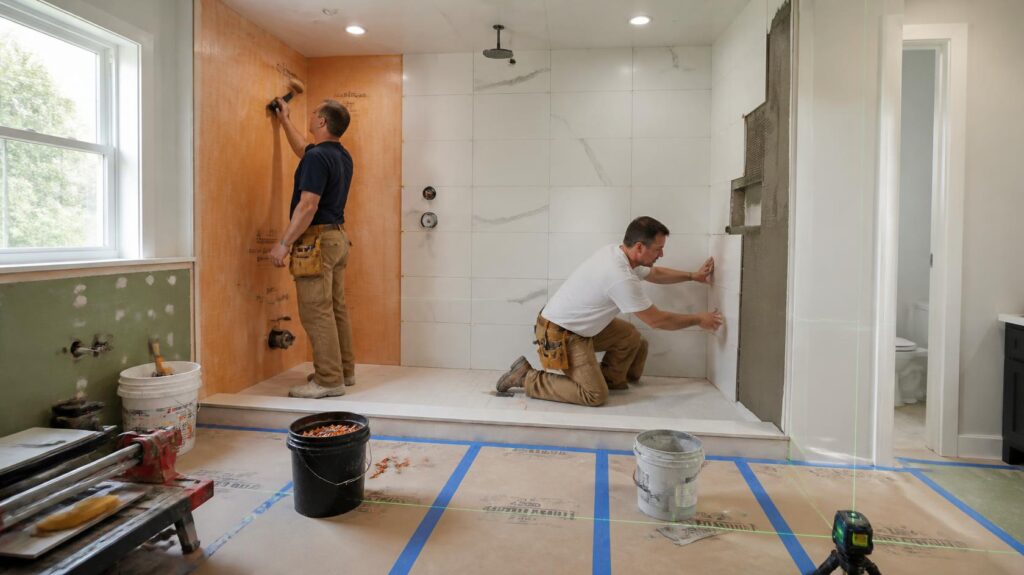
Every builder brochure sells curbless as a styling choice. The construction is the expensive part.
To drop the shower floor flush with the bathroom floor, someone has to recess the framing. That means notching or sistering joists, or building the rest of the room up to meet the shower. Add a linear drain, a wider mortar slope, and the extra waterproofing a flat threshold demands. The premium over a curbed tiled shower usually runs $2,000 to $4,000.
Walk-in shower cost: Going doorless saves the $500 to $3,000 you would have spent on glass. It needs a longer wet zone, though, so you often hand that saving straight back in tile.
Concrete slab homes are the exception. There is no joist to cut, so a curbless build there can cost barely more than a curbed one.
Permits, Inspections and the Costs That Land Late
The permit itself is little money, $30 to $500 in most jurisdictions. Treat it as a schedule item instead of a flat fee, and it stops hurting.
Most building departments want to see the shower pan water test before anything gets covered. The installer plugs the drain, fills the pan, and an inspector confirms it holds. Miss that booking and tile work stalls for days while the crew sits idle on your job or, worse, moves to someone else’s.
Four more costs that show up after the estimate is signed:
- Rotten subfloor found under the old tub, $400 to $1,200 to cut out and replace.
- Galvanized supply lines that crumble when touched, $600 to $2,000 to repipe.
- An exhaust fan that fails code for the new wet area, $250 to $700.
- Drywall, paint and ceiling patching once the demolition dust settles, $300 to $900.
What the Shower Costs You After Handover?
Some costs never appear in a bid, and they run for twenty years.
Start with the showerhead. The federal maximum flow rate is 2.5 gallons per minute. The EPA WaterSense label caps a labeled model at 2.0 gallons per minute. EPA estimates the average family saves 2,700 gallons of water a year by switching to a WaterSense-labeled showerhead. On a metered water and gas bill, that is real money against a fixture that costs no more than any other.
Then there is upkeep. Grout wants resealing every year or two, and glass wants a squeegee unless you enjoy scrubbing mineral film. Two habits protect the investment—first, clean grout lines safely instead of reaching for acid. Second, treat the first sign of pink mold in the shower as a ventilation problem, not a cleaning one.
Get Three Itemized Bids Before You Sign
Book three licensed local contractors this week and hand each one the ten-row list above. Ask every bidder for the waterproofing system by brand, the glass thickness in inches, the permit fee, and a firm start date in writing. Choose the bid that explains its numbers, not the one that hides them.
Frequently Asked Questions
Usually yes. A basic alcove tub with a surround can be installed for $1,500 to $4,500, well under most shower builds, because it needs no waterproofed pan and no glass.
Prefab swaps take one to three days. Tiled builds take seven to fourteen working days once curing and inspections are counted, and roughly a third of homeowners report three to four weeks door to door.
If plumbing moves or walls change, almost always. Like-for-like fixture swaps sometimes escape it. Call your building department before demolition, not after.
Thirty-six by thirty-six inches is the practical floor size for comfort and the ADA transfer size. Thirty-six by sixty inches is the sweet spot most tub footprints allow.
For a dated bath with one tub already elsewhere in the house, yes. Bathroom updates recover roughly half their cost at resale, and the daily use value covers the rest.
